
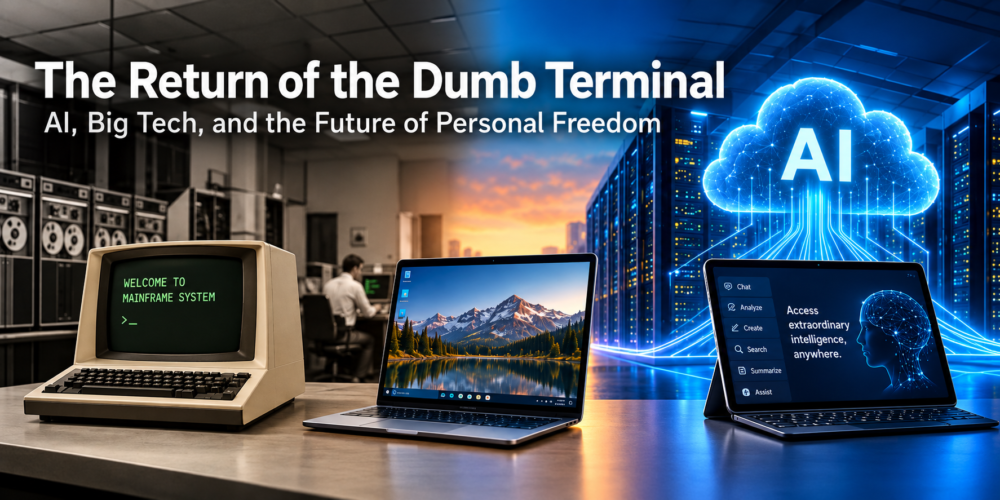
Artificial intelligence may be pushing computing back toward centralized infrastructure. But as our devices become smarter, are we surrendering privacy, independence, and control over our digital lives?
By Kourosh Tari
The Computer Revolution May Be Going in Reverse
For decades, personal computing followed a remarkable trajectory. Computers became smaller, faster, more powerful, and more affordable. Machines that once filled rooms eventually sat on our desks, then slipped into our bags and pockets.
That change was more than a triumph of engineering. It was a transfer of power. Individuals could buy a computer, install software, store private documents, and accomplish meaningful work without asking a large institution for access to its machines.
Today, I wonder whether artificial intelligence is beginning to reverse that trajectory.
AI systems demand enormous amounts of processing power, memory bandwidth, storage, networking, and electricity. Meanwhile, cloud services can deliver increasingly sophisticated capabilities to modest devices. Together, these forces could make powerful personal hardware less essential for everyday computing.
Could the era of the dumb terminal be returning—only this time, not so dumb?
I think it could. But the price of this transition may not be measured primarily in dollars. It may be measured in privacy, autonomy, and the concentration of power.
From Mainframes to Personal Independence
In the early decades of computing, large organizations owned the computers. Many users interacted with central machines through terminals that did little more than send keystrokes and display results. The processing and data lived elsewhere.
The personal computer changed that relationship. Affordable microprocessors and software put substantial computing capabilities directly into people’s hands. Ownership of the machine meant meaningful control over the applications and information on it.
That independence was never absolute. Proprietary software, hardware vendors, and later internet services all imposed constraints. Still, the personal computer created an important alternative to institutional computing: a person could work on their own machine, often without a network connection.
Over time, the internet made remote services so convenient that we gradually moved email, photographs, documents, and applications off our own devices. We gained synchronization, collaboration, and backup. We also became dependent on service providers in ways that were easy to overlook.
AI Changes the Economics
The scale of modern AI infrastructure is extraordinary. Training and serving advanced models requires specialized accelerators and large, interconnected data centers. Those systems compete for some of the same semiconductor manufacturing resources used throughout the electronics industry.
That competition can put pressure on component supply and pricing, including certain types of memory and storage. It does not prove that affordable laptops will disappear. Manufacturing capacity can expand; smaller models can become more efficient; consumer hardware can improve even as data-center investment grows.
Nevertheless, the economic question is compelling. Why buy a very powerful computer for routine tasks if a less expensive device can connect to much more capable systems on demand?
For writing, research, customer service, business workflows, and some forms of development, users may increasingly value access to capable AI services over the specifications of the processor in front of them. For gaming, media production, engineering, offline work, and sensitive processing, powerful local computers may remain essential.
My prediction is not that the personal computer vanishes. It is that the center of gravity of mainstream computing moves away from the device and toward a hybrid of local intelligence and remote capability.
The Intelligent Terminal
Tomorrow’s terminal could be a laptop, a smartphone connected to a display, or a device we have not yet named. Unlike its predecessor, it would have its own processor, secure storage, and perhaps a capable local AI model. It could perform ordinary tasks independently, then call on remote infrastructure for heavy work.
A well-designed device could choose where a task runs based on cost, latency, connectivity, energy use, and privacy. A private note might stay local. A complex simulation might run remotely. A research request might use cloud AI without uploading the user’s entire personal archive.
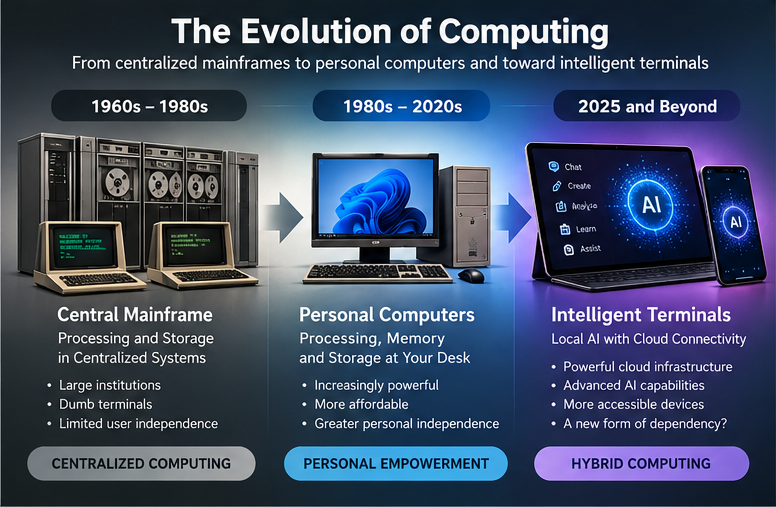
This could be a remarkable advance in accessibility and affordability. But it also brings us to the question that concerns me most: if our intelligence and information increasingly reside elsewhere, who controls them?
Big Tech Is Becoming the New Mainframe Operator
A small group of technology companies operates much of the infrastructure on which digital life depends: cloud platforms, operating systems, identity systems, app marketplaces, advertising networks, and increasingly AI services. Their investments have enabled genuine innovation, security improvements, and global access to useful tools.
Those achievements deserve recognition. They do not justify immunity from criticism.
When one company controls several layers of a user’s digital environment, it can shape which services are available, how data moves, what users pay, and how easily they can leave. Not every restriction is abusive; some protect security or reliability. But the concentration of control creates the capacity for abuse, and the practical costs of switching providers can make that power difficult to challenge.
No corporation should become the unquestioned gatekeeper of our digital lives simply because its technology is useful.
I am not arguing that every large technology company is acting maliciously. I am arguing that trust should not be the sole safeguard when a company holds essential infrastructure and deeply personal information. Accountability, competition, technical protections, and meaningful alternatives matter.
Security Is Not the Same as Privacy
Cloud services can provide excellent security. A major provider may defend against attacks more effectively than an individual running an unpatched computer. Remote backup can also protect data from device theft, hardware failure, and disasters.
But security against outside attackers is not identical to privacy from the service operator. Depending on the product and its design, a provider may have technical access to stored content, metadata, or information submitted for AI processing. Contractual terms and retention practices differ across services.
Users also face account suspensions, outages, policy changes, and lawful government requests for data. Those risks do not mean cloud services should never be used. They mean that sensitive information should not be handed over indiscriminately, and users should understand what protections actually apply.
AI Turns Stored Data Into Personal Intelligence
AI intensifies this problem because it can do more than store information. With access to enough data, it can analyze correspondence, calendars, documents, and other records; connect patterns across them; and infer details that a person never explicitly disclosed.
Someone’s messages might reveal relationships. A series of calendar entries and receipts might suggest health or financial circumstances. Seemingly mundane fragments can become revealing when combined at scale.
These inferences are not always accurate. That is part of the danger: an incorrect conclusion can still influence how a person is profiled or treated.
The privacy challenge of the AI era is not only what we reveal. It is what powerful systems can infer about us.
When Surveillance Becomes Cheap
Historically, examining large volumes of personal information required significant human effort. AI can reduce the cost of searching, classifying, summarizing, and correlating that information. Capabilities that once required teams of analysts can increasingly be automated.
This does not mean every cloud provider is conducting mass surveillance. It means the economics of surveillance are changing. A capability can become widely available long before society agrees on acceptable limits for its use.
That matters for both corporate and government power. Commercial profiling, workplace monitoring, and state investigations raise different legal and ethical questions, but all can become more intrusive when detailed analysis is cheap and scalable.
We should not wait for a spectacular abuse before insisting on limits. Privacy protections should constrain access, collection, retention, and secondary use—not merely promise responsible behavior after information has already been gathered.
From Ownership to Dependency
Imagine that your files, applications, digital identity, and AI assistant all depend on one company’s infrastructure. What happens if prices rise sharply, the service changes direction, your account is suspended, or the network goes down?
A person might technically “own” their documents but be unable to open them outside a proprietary system. They might export chat histories but lose the tools or context needed to make those histories useful. They might have little bargaining power because moving away is costly.
Ownership without practical control is a fragile kind of ownership.
Subscription computing can be economical and convenient, especially for people who cannot afford expensive equipment. Yet its true cost includes recurring fees, dependence on connectivity, and the possibility of lock-in. We should evaluate all of those costs, not just the purchase price of the terminal.
A Better Model: Privacy-First Hybrid Computing
I do not advocate abandoning AI or cloud computing. The better path is to design systems that use remote resources selectively while preserving meaningful local control.
In a privacy-first hybrid model, personal documents and credentials would remain encrypted under the user’s control whenever practical. Local AI could handle sensitive requests. A task router could decide when cloud processing is necessary and ask for permission before transmitting sensitive material.
When remote computation is needed, the system should minimize the data it sends. In some cases it could send a question or a carefully limited excerpt rather than a complete document collection. For other tasks, sending sensitive information may be unavoidable; the device should say so clearly.
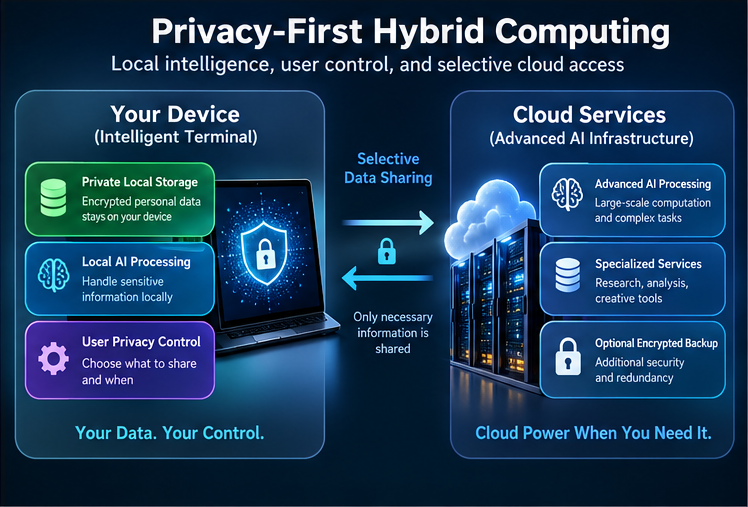
This architecture is not magic. Local devices can be stolen or compromised. Cloud services may still see prompts and metadata. Encryption protects data only when key management and access controls are designed correctly. And local AI may be less capable than the best remote systems.
But these are engineering challenges worth solving. The goal is not absolute isolation. It is informed choice, reduced exposure, and freedom to operate independently.
What Should Change?
Privacy by Design
Devices and applications should favor local processing for sensitive tasks when feasible. Remote data sharing should be visible, limited, and understandable.
Real Portability and Interoperability
People should be able to export files, settings, and relevant AI history in useful formats and move between providers without prohibitive friction. Open standards can make competition real rather than theoretical.
Strong Limits on Secondary Use
Providers should clearly distinguish information needed to deliver a service from information used for advertising, profiling, model training, or other purposes. Meaningful consent and enforceable retention limits matter.
Independent and Offline Options
Local applications, local AI models, and offline access to essential files should remain viable. A temporary outage should not render a person’s digital life inaccessible.
Accountability Without Expanded Surveillance
Governments can protect privacy and competition through enforceable rules. But oversight must not become a pretext for weakening encryption or giving public authorities unnecessary access to personal data.
My Predictions for 2035
First: For mainstream users, the capability of accessible AI services will matter more than raw local processor specifications.
Second: Intelligent terminals—lightweight laptops, tablets, phones, and new device formats—will become more common, though powerful local machines will remain important for specialized work.
Third: Computing subscriptions will grow. That may lower upfront costs but increase the importance of portability, predictable pricing, and competition.
Fourth: Privacy will become a more visible differentiator. Products that can demonstrate local processing, minimized collection, and meaningful user control may earn greater trust.
Fifth: The smartphone could become the center of many people’s computing environment, adapting to a desk, a vehicle, or a wearable display while drawing on remote resources as needed.
Sixth: The most important design innovation may be an intelligent, privacy-aware division of labor between local devices and the cloud.
These are predictions, not inevitabilities. Improvements in affordable local AI, network constraints, regulation, and consumer preferences could shift the outcome substantially.
The Future Should Still Belong to the Individual
I am optimistic about artificial intelligence. It can expand access to knowledge, increase productivity, and help people accomplish things that once required extraordinary resources. Cloud computing is an important part of that promise.
But progress should not be measured only in model benchmarks, data-center capacity, or the price of a device. It should also be measured by whether people retain meaningful control over their information and the tools they depend upon.
The personal computer revolution moved computing power out of large institutions and into individual hands. We should not casually surrender that achievement in exchange for convenience.
Perhaps the dumb terminal really is coming back. Only this time, it may be extraordinarily intelligent.
A future in which computers become more intelligent while individuals become less independent is not necessarily progress.
After spending half a century putting computers on everyone’s desk, we may be preparing to take the computer back off the desk.
Let’s make certain we don’t take personal freedom with it.
What do you think? Will AI make powerful personal computers less necessary—and how much control over our data should we be willing to give up for the convenience of cloud intelligence?
Join the Conversation on LinkedIn
Will artificial intelligence make us more independent, or more dependent on Big Tech? I’d love to hear your perspective.
Discuss This Article on LinkedIn →
 Kourosh